
.png)
Combat AI-Inflated CVs With Skill-Based Hospitality Hiring
by Deya Bhattacharya | October 9, 2026 | HR TRENDS, RECRUITMENT TIPS
In 2026, the hospitality industry continues to face rapid turnover and seasonal demand shifts. The UK hospitality sector lost about 170,000 jobs in the thirteen months after the October 2024 budget, while Europe in general is missing roughly 10% of the hospitality workers it needs. Finding and onboarding suitable candidates for those roles in a timely fashion is hard enough. On top of that, recruiters have had to contend with a new wave of job applications featuring AI-inflated CVs that read like a list of stellar accomplishments — but are often not backed up by the facts.
The hard truth is that AI is not going anywhere. There are, however, ways to cut past AI fluff and find authentic matches for every hospitality job. Here, we take a closer look at AI-inflated CVs and the difficulties they can cause — and how skills-based hiring helps recruiters find genuine hospitality talent much sooner.
What is AI-based CV inflation?
AI-based CV inflation refers to the practice of using AI tools like ChatGPT or Claude to boost a CV so that it optimally matches the given job description. This could take the form of exaggerating the candidate’s existing background or adding entirely fictional qualifications, experience or skill sets for a more impressive look.
It’s become common to ask AI tools to look over CVs and flag any errors or areas of improvement before applying. However, many applications use AI to artificially optimise their resume by copy-pasting the job description and asking the LLM to insert the criteria being asked for. With enough tweaking, any and every CV can be made to look like an expert’s — and if it contains the right keywords, the recruiter’s ATS will pass it on to the next screening round.
How to spot an AI-inflated CV
There are certain tells that indicate the possible use of AI to inflate one’s resume:
- Generic language — The presence of certain overused buzzwords could indicate an AI-inflated CV. Words and phrases to watch out for include “leveraged”, “spearheaded”, “highly motivated” or “demonstrated history of X”.
- Vague numbers — Some AI-inflated resumes may include points like “improved revenue by X%” without context around the timeline, previous revenue numbers or department-specific details.
- Punctuation — AI-generated content tends to be heavy on em dashes.
The caveat: While these signs could indicate CV inflation, they could also point to a candidate who might not be fluent in the language and thus run their CV through the LLM to sound “correct”. This is where direct connection with the candidate matters to establish genuine ability over generic corporate-speak.
Why AI-inflated CVs hurt the recruitment process
Any kind of recruitment comes with a risk that the hire might not work out. With the rise of AI-inflated CVs, however, the risk is even higher, as the veracity of the candidate comes into question from the get-go. Potential difficulties include:
- Frustration leading to errors — Sorting through hundreds of CVs to try and weed out AI can, understandably, be frustrating for recruiters. This makes them more likely to give up halfway and pick whoever seems best at the moment.
- Delays in hiring — It can take multiple rounds of interviews to catch the lies of those who have used AI to inflate their CVs, leading to delays in filling critical roles.
- Poorer chances for genuine candidates — The risk of relying on an anonymous pool of applicants is that you cannot separate the genuine from the fakers in any meaningful way. In an already competitive market, this can hurt the chances of those who are genuinely equipped to excel at the role being offered rather than those who merely claim to be so.
- Exclusionary hiring — An AI-inflated resume with impressively presented skills and certifications might be selected over a CV of someone genuinely skilled but who graduated from a less prestigious university, making it harder for them to break into the industry.
- Overt suspicion about AI — A frustrated manager may reach a breaking point where even genuinely impressive CVs are suspected as AI, further complicating the recruitment process and slowing down hiring cycles.
The use of AI detectors to catch fake resumes might seem like an obvious solution. However, EU GDPR regulations have strict rules around transparency when it comes to processing data. Given that AI detectors are primarily third-party software applications, they frequently do not disclose their operational processes, which could lead to significant compliance issues for the recruiting company.
How skills-based hiring cuts through AI-based CV inflation
At the end of the day, any CV — whether genuine or AI-inflated — is a piece of paper. A candidate’s real suitability for the role depends on concrete proof, which is why many hospitality recruiters are turning to skills-based hiring.
- Focus on proof, not promises — Skills-based hiring doesn’t just take a candidate’s word for what they can do. It looks for demonstrated proof in the form of numbers, facts and awards, thus bypassing the generic keywords that AI-inflated resumes can be tweaked to meet.
- Includes skill demonstrations — Live simulations or project-based interviews make it easier to validate what the candidate actually brings to the table.
- Enables better job fit — The candidate with the most impressive qualifications (even the genuine ones) may not always be the best fit for the job. Skills-based hiring gives a fairer chance to those who may have more modest degrees but better on-the-job abilities.
Practical tips for hospitality managers to implement skills-based hiring
While some AI-inflated CVs may always slip through the cracks, implementing the following will make it easier for hospitality recruiters to reach the candidates who are truly worthy.
Invest in the right AI
Using AI to avoid AI might sound ironic, but AI isn’t the enemy if used smartly. For instance, Hosco’s AI-powered pre-screening agent sorts through resumes, and pre-screens and conducts preliminary video interviews, thus eliminating the burden of verifying qualifications and experience at a basic level. It can be used with Hosco’s own ATS, or plugged in with your hotel’s existing ATS.
Design interviews with a focus on skill-based deep dives
Instead of asking generic questions like “describe one way you overcame adversity”, ask candidates to describe their approaches to workplace scenarios based on the experiences they have highlighted in their CV. Including a practical round (such as a live project or customer interaction simulation) is another good way to see evidence of job suitability in person.
Tap into verified hospitality talent networks such as Hosco
Rather than relying on generic job platforms (where verifiability is low and the risk of AI-inflated CVs is high, we recommend finding talent on Hosco: a hospitality-specific talent network where every candidate has been pre-vetted. This reduces the dependence on the CV alone and enables recruiters to shortlist based on concrete evidence.
Table 1: Hiring candidates with traditional resumes vs candidates with profiles on Hosco
| Candidate Verification | Traditional Resumes | Candidate profiles on Hosco’s platform |
|---|---|---|
| Experience | Self-reported text with a higher risk of AI-generated fluff | Authentic hotel school credentials plus insight into career pathways |
| Soft Skills & Physical Presence | Self-reported with overused keywords and little verifiable information | Opportunities for intros and direct messaging to build preliminary relationships |
| Language Fluency | Unverified self-rating | Role-relevant language profiling based on standardised fluency metrics |
| Job-specific Readiness | Self-reported description of duties fulfilled | Verified internships and graduate school projects to demonstrate track records |
| HR Screening Effort | High, requires multiple interview rounds to catch exaggerations | Low, thanks to instant filtering based on verified qualifications and experience |
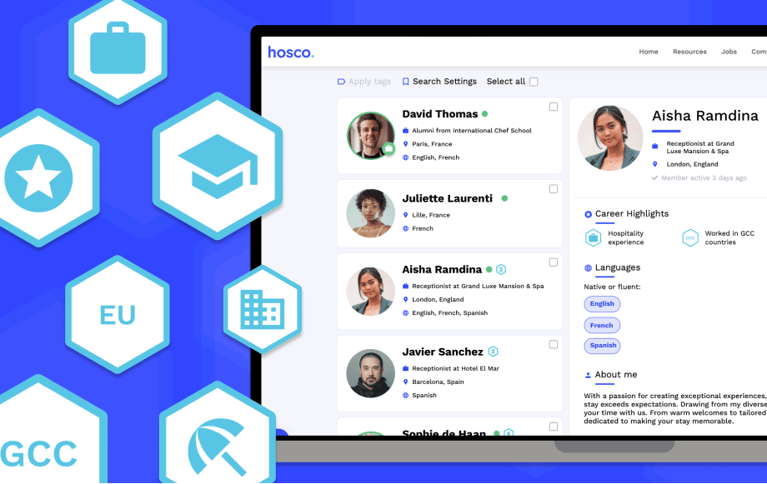
Hosco connects hotel employers directly with a network of over two million verified hospitality professionals and graduates from premier institutes. The platform makes finding authentic talent easier than ever through:
- Niche-specific candidate match based on seven search filters
- Verified institutional badges for every hotel school the candidate attended
- Opportunities for relationship building through real conversations before a formal interview
Hospitality hiring can be a challenge, but Hosco’s verified network of top-tier professionals makes it easier to find the right candidates for every role, seniority level, and department. Sign up today and experience how Hosco connects you with top-notch talent to support your hospitality hiring goals.
MORE RELATED CONTENT



Ready to hire on Hosco? Create your company account.
Want to enhance your people strategy
and keep it up to date? Subscribe to our blog.